Sunday, December 04, 2022

Triplex Numbers

A couple of years ago I stumbled upon this video by someone calling himself "Casual Graphman":


You really need to watch the video first before continuing, but basically the author constructed a unital algebra called the "triplex numbers". It's reminiscent of the split-complex numbers, except instead of \(j^2=1\) the author defines \(j^3=i^3=1,j^2=i,i^2=j\). This triplex number system is three-dimensional with basis \(\{1,i,j\}\) and each triplex number has the form \(a + bi + cj\), where \(a,b,c\) are real numbers.

Around the time I discovered this video, I was in the early stages of my abstract algebra adventures. By then the seeds of what would become the polytopic groups and polytopic algebras were just starting to germinate in my mind. I remember getting stuck trying to make sense of a group whose convex hull was a \(\bf{3}\)-simplex and being intrigued by this video because of the similarity between the third roots of unity (that form a triangle in the complex plane) and the basis of triplex space: both were cyclic groups of order three under multiplication.

The connection went even deeper when, to my utter astonishment, I learned that a polytopic group of a regular tetrahedron exists in triplex space, generated by \(\left\langle{-\frac{1}{3}+\frac{(\sqrt{3}-1)}{3}i-\frac{\sqrt{3}+1}{3}j}\right\rangle\):

The person I learned this from (anixx from the Math Stack Exchange website) used a slightly different notation: He preferred \(\bf{j}\) and \(\bf{k}\) instead of \(i\) and \(j\), probably to not cause ambiguity with complex numbers, so what he actually showed me was more like \(-\frac{1}{3}+\frac{(\sqrt{3}-1)}{3}j-\frac{\sqrt{3}+1}{3}k\). Here's what the group looks like:

\[\left\{-\frac{1}{3}+\frac{(\sqrt{3}-1)}{3}j-\frac{(\sqrt{3}+1)}{3}k,\quad-\frac{1}{3}+\frac{2}{3}j+\frac{2}{3}k,\quad-\frac{1}{3}-\frac{(\sqrt{3}+1)}{3}j+\frac{(\sqrt{3}-1)}{3}k,\quad{1}\right\}\]

I will use \(j\) and \(k\) for the rest of this post to make comparisons with complex numbers easier. And since it is a three-dimensional polytopic algebra based on a \(3\)-orthoplexic group (generated by  \(\left\langle{-j}\right\rangle\)), I will use the following notation for the triplex algebra: \(\bf{\Bbb{X}_3}\)

Monday, October 24, 2022

Abstract Algebra Adventures Part 5: Homogeneous Forms of \(\Bbb{X}_{n}\)

Previously I discussed a family of algebras with \(n\) dimensions with finite cyclic subgroups that also span \(n\) dimensions. These are what I call polytopic algebras (denoted as \(\Bbb{X}_{n}\)) because the convex hull of those cyclic subgroups are \(n\)-polytopes.

"Polytopic group" is what I call any finite cyclic group that exists in a unital algebra. A polytopic group has \(n\) dimensions if its elements span an \(n\)-dimensional subspace. An \(n\)-dimensional algebra is only polytopic if it has \(n\)-dimensional polytopic groups.

I also showed a general way of finding polytopic groups in \(\Bbb{X}_{n}\), and I claimed that we could use \(n\)-dimensional polytopic groups as the basis of \((n+1)\)-rational numbers. In this post I'll try to prove that claim.


Wednesday, October 19, 2022

Flashback to 2005-04-02: My Very Own Chess Variant

(Behold my 18-year old self back when I created a chess variant involving an augmented knight. This is from my old blog, and I'm reproducing it here with just a few minor tweaks, because I'm still sort of proud of this creation.    -Present Day Francis)

---

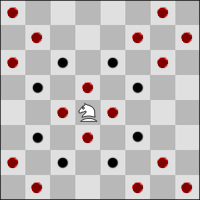
Yesterday, I was thinking about a very unique kind of chess piece: the knight. Technically, the knight is a (2,1) leaper, meaning, it moves two squares in one direction, then one square in a perpendicular direction (see black dots in picture); and it can "leap" over pieces. So, as I was saying, I was thinking about the knight, then I suddenly had the urge to improve it (or to use the chess variation lingo, "augment it"). What if, I asked myself, there was a chess variant where the knight is an (n, n-1) leaper? It could still move like the orthodox knight (i.e. n = 2), but it would be far more powerful.


(The knight as an (n, n-1) leaper.)

Powerful. That's the word. I realized that such a piece was simply too powerful for serious players to like. Imagine a piece that could leap over any number of pieces to land on almost the opposite side of the board, attacking at a maximum of 24 squares (near the center) and a minimum of 14 (on an edge). Then imagine four of those pieces on a single chessboard. The words "cheap" and "overkill" come to mind. Basically, the only way for my idea to be acceptable is to limit this augmented knight somehow...But what would be an elegant way of doing this?

Sunday, October 16, 2022

Abstract Algebra Adventures Part 4: Polytopic Algebras


In the complex plane, a regular convex \(n\)-sided polygon is the convex hull of a finite cyclic group of order \(n\) under multiplication. This cyclic group is of course the \(n\)th roots of unity in \(\Bbb{C}\).

Given this relationship between convex \(2\)-polytopes and roots of unity in that \(2\)-dimensional algebra, let's try to construct a family of algebras such that if a member algebra is \(n\)-dimensional, it has cyclic subgroups under multiplication whose convex hull is an \(n\)-polytope.

Aside from the aforementioned case with polygons, mathematicians don't usually associate cyclic groups with polytopes. Rather, it is the symmetry groups that commonly comes to mind whenever polytopes are mentioned in the context of abstract algebra. But I'd like to show that there is a very natural notion of dimensionality within finite cyclic groups under any unital algebra's multiplication operation, and that it's not always just the two dimensions of the roots of unity in the complex plane.


Polytopic Groups and Algebras


Let's define a "polytopic group" to be a finite cyclic group whose group operation is the multiplication operation of a certain algebra. The span of the group's elements within the algebra's vector space determines the polytopic group's dimensionality, and its convex hull is a polytope with the same dimensionality.

Let's also define an "\(\bf{n}\)-polytopic algebra" as an \(n\)-dimensional real algebra with \(n\)-dimensional polytopic subgroups. Meaning, the dimensionality of the algebra and its highest-dimensional polytopic subgroup is the same.

We can thus say that \(\Bbb{C}\) is a \(2\)-polytopic algebra and \(\Bbb{R}\) is a \(1\)-polytopic algebra. Unfortunately, \(\Bbb{H}\) (the quaternions) and Cayley-Dickson constructions derived from it are NOT polytopic algebras, but they do have \(2\)-polytopic subalgebras. Also, all unital algebras contain the \(1\)-polytopic subalgebra \(\Bbb{R}\).

The following is my attempt at constructing other polytopic algebras. Note that I will be focusing on algebras over the field of real numbers, but you are free to try this exercise for other fields.


Friday, October 14, 2022

Abstract Algebra Adventures Part 3: Multirational numbers

In my previous post I discussed the trirational numbers, which are representations of complex numbers that can also represent ratios of three numbers. Now let's look at the generalization that represents ratios of \(n\) numbers: the \(n\)-rational numbers, or more generally the multirational numbers.

\[r\unicode{x25B6}d_1\unicode{x25B6}d_2\unicode{x25B6}\dots\unicode{x25B6}d_{n-1}\]

Here, \(r\in\Bbb{R}\) is called the numerator while \(d_1,\dots,d_{n-1}\in\Bbb{R}_{>0}\) are the denominators of the \(n\)-rational number.

We can say that a trirational number \(a\unicode{x25B6}b\unicode{x25B6}c\) is a \(3\)-rational number, while a fraction \(\frac{a}{b}\) is a \(2\)-rational number that can be written as \(a\unicode{x25B6}b\) (if \(b\) is positive) or \((\operatorname{sgn}(b)*a)\unicode{x25B6}{|b|}\).


Ratios and the scaling rule 

When you scale each component of a ratio by the same amount, the ratio stays the same. The same applies to multirationals because of this identity:

\[x\unicode{x25B6}x\unicode{x25B6}\dots\unicode{x25B6}x=1\]

This property allows fractions and trirational numbers to act as homogeneous forms for real numbers and complex numbers, respectively.

We'll go back to this concept of homogeneous forms near the end of this post, but first let's look at \(n\)-rational operations without referencing the ambient algebra.

Friday, October 07, 2022

Abstract Algebra Adventures Part 2: Trirational numbers

Complex numbers are often written in their rectangular form \(a + bi\) where \(a\) and \(b\) are real numbers and \(i\) is an imaginary square root of \(-1\). If we visualize the real number line and the imaginary number line as the orthogonal axes of a Cartesian plane, we could say that \((a,b)\) are the complex number's Cartesian coordinates.

Another useful way to represent complex numbers is via their polar form \(re^{\theta{i}}\), which emphasizes the vector-like nature of complex numbers. In this form, \(r\) is a real number denoting the magnitude of the vector and \(\theta\) is the angle between the positive real axis and the vector. This form is related to another coordinate system: the polar coordinates; the polar coordinates in this case are \((r,\theta)\). We can convert a complex number's polar form to its rectangular form with the help of Euler's formula: \(e^{i\theta}=\cos(\theta) + i\sin(\theta)\).

This post is about a third form for complex numbers. This time, it's based on a type of homogeneous coordinates.


Definitions

By "homogeneous coordinates" I specifically mean coordinates that still represent the same point after each coordinate is scaled by the same amount. Meaning that for a set of, say, three coordinates \((a:b:c)\), we consider them to be homogeneous when \((xa:xb:xc)=(a:b:c)\) for any non-zero positive real number \(x\).

Examples of homogeneous coordinate systems are projective coordinates and barycentric coordinates. But here we will talk about something a bit different from those two.

Given \(a \in{\Bbb{R}}\) and \(b,c \in{\Bbb{R}_{>0}}\), the homogeneous coordinates \((a:b:c)\) can be represented by a complex number written in this form:

\[a*b^{\omega}*c^{\omega^2}\]

where \(\omega=-\frac{1}{2} + i\frac{\sqrt{3}}{2}\) and \(\omega^2=-\frac{1}{2} - i\frac{\sqrt{3}}{2}\) are the primitive third roots of unity.

The third roots of unity have this nice property:

\[1+\omega+\omega^2=0\]

Which means for any non-zero positive number \(x\),

\[x*x^{\omega}*x^{\omega^2}=x^{1+\omega+\omega^2}=1\]

\[\therefore{(xa)*(xb)^{\omega}*(xc)^{\omega^2}=a*b^{\omega}*c^{\omega^2}}\]

In other words, scaling all three components by the same amount does not change the value of the number. This is exactly what we expect from homogeneous coordinates \((a:b:c)\).

(The reason why I'm limiting \(b\) and \(c\) to non-zero positive reals here is because there's no widely accepted method for evaluating complex powers of a negative number or of zero. Readers could try playing with negative denominators if they wish using their own methods. I also have a section below for cases where \(b\) and/or \(c\) are complex numbers, but I want to start this off with the simpler case of real numbers.)


Trirational numbers

For convenience, we'll also use the notation \(a\unicode{x25B6}b\unicode{x25B6}c\), which we'll call a "trirational number" as an analogy to the rational numbers (see the "Comparison to fractions" section below for more on this analogy).

\[a\unicode{x25B6}b\unicode{x25B6}c\overset{\text{def}}{=}a*b^{\omega}*c^{\omega^2}\]

We'll call \(a\) the "numerator" of the trirational number while \(b\) and \(c\) are the two positive "denominators" of the trirational number.

We can also write trirational numbers vertically:

\[\begin{matrix}
a \\[-5pt]
\unicode{x25BC} \\[-5pt]
b \\[-5pt]
\unicode{x25BC} \\[-5pt]
c \\[-5pt]
\end{matrix}\quad\text{or}\quad\begin{matrix}a \\
\unicode{x25B6}b \\
\unicode{x25B6}c \\
\end{matrix}\]

Abstract Algebra Adventures Part 1: Introduction

I'm one of those people who had good grades in Math back in school but who promptly forgot a lot about the subject as soon as it no longer really mattered. As an average non-mathematician adult nerd, I do occasionally read math-related articles on Wikipedia for fun, and I'm subscribed to several "MathTubers", but for most of my life I couldn't really say that math was a passion of mine, and it shows by how little of what I read/watch actually sticks to my head.

I think I'm starting to develop a taste for abstract algebra, though. You could say it became my pandemic hobby. 😆 Take note that I never took any abstract algebra classes back in college, so this was quite a journey for me, to say the least.

No, I still haven't taken any formal classes or anything like that. So far I've only been learning things bit by bit, not as part of a systematic abstract algebra course, but as stepping stones to answer questions that actually interest me.

For example, I once wondered how to position three points on the complex plane in the "nicest" way possible. At first "nicest" was pretty vague and I didn't really know exactly what I was looking for, but eventually I learned about the third roots of unity \(-\frac{1}{2} \pm i\frac{\sqrt{3}}{2}\) and their many cool properties. As I learned more, my questions became more informed and more specific, and soon enough I started having a better understanding and appreciation for certain math topics:

  • roots of unity and cyclic groups in general
  • quaternions, octonions, etc. (I already knew about \(i^2=j^2=k^2=ijk=-1\), but I didn't start playing with quaternion rotations and stuff like that until all this happened)
  • Geometric/Clifford algebras
  • other unital algebras over the field of real numbers
  • regular and uniform polytopes and their connection to abstract algebra
I also learned way more linear algebra than I bargained for. As someone who's always had an irrational dislike for matrices, I have begrudgingly accepted their utility, especially since there are tools I could use to easily work with them without doing things by hand.

Speaking of tools, websites like Wolfram Alpha and matrixcalc.org, as well as the small programs that I wrote to study the things mentioned above, all gave me enough confidence to create my own algebraic structures despite my lack of mathematical talent.

As for the value/usefulness of those structures I created, well, I have no idea. I'll describe them later in this series of posts, then maybe actual mathematicians could take a look and provide their insight if they wish. But at this point it's all just fun and games to me.

Continued in Part 2.

I'm blogging again!

You read that right. After years of false starts, I think I'm ready to get back to blogging.

If you're one of the few people who used to read my old blog, you might notice that I've disabled public viewing. I plan to move my favorite posts from there to here, then afterwards I will be deleting that blog permanently.

The reasons for this are deeply personal, so I don't know if I'll ever talk about it. Honestly I have so many other things I'd rather talk about instead, so let's just wrap up this "introductory post" and get to the fun stuff, shall we?