(Behold my 18-year old self back when I created a chess variant involving an augmented knight. This is from my old blog, and I'm reproducing it here with just a few minor tweaks, because I'm still sort of proud of this creation. -Present Day Francis)
---
Yesterday, I was thinking about a very unique kind of chess piece: the knight. Technically, the knight is a (2,1) leaper, meaning, it moves two squares in one direction, then one square in a perpendicular direction (see black dots in picture); and it can "leap" over pieces. So, as I was saying, I was thinking about the knight, then I suddenly had the urge to improve it (or to use the chess variation lingo, "augment it"). What if, I asked myself, there was a chess variant where the knight is an (n, n-1) leaper? It could still move like the orthodox knight (i.e. n = 2), but it would be far more powerful.
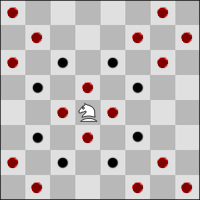
(The knight as an (n, n-1) leaper.)
Before I could answer that question, I decided to map out the theoretical knight's moves on a chessboard first (see picture above). That's when I noticed the crossed diagonal pattern, obviously reminding me of the bishop. I decided that whatever I name this new piece, it will have to be something that combines religion (bishop) and war (knight). Then it struck me: the crusader! Crusaders were medieval knights who went on religious quests.
And just like that, my dilemma is solved. I finally had a way to make my theoretical improved knight work in real chess games. And the answer is: la croisade.
The obvious answer to the problem of unfair advantage is some sort of promotion mechanism (like that of the pawn), such that the knight will retain its normal moves until it is promoted. I devised a way such that the knight could be promoted as a very powerful piece, but only temporarily. This is how it goes: Once a king is checked, an event that I call la croisade (French for "the crusade") shall occur, whereby the threatened party's knights shall temporarily become "crusaders", which are (n,n-1) leapers, for as long as the king is in check. Only the threatened party's knights are promoted; the attacker's knights stay the same. La croisade ceases the moment the threat passes, after which the knights revert to their original selves.
There are a few interesting things I noticed about this rule. First, a new kind of discovered check is formed. If a checking move involves the attacker's own king being threatened by a crusader, it is a discovered check by that crusader.
The la croisade is either useful or embarrassingly useless. Imagine having a piece arguably more powerful than the Queen, but is unfortunately out of range to help a king, rendering it incapable of doing its only job. The la croisade is only a reaction to a threat, never an initiative. So the seemingly unfair range of moves of the crusader isn't really unfair at all. Problem solved.
Here are a couple of incomplete sample games featuring la croisade:
Incidentally, the Fool's Mate (1. f3 e6 2. g4 Qh4++) still works even with la croisade. (So...it really IS a fool's mate! :-P)
And just like that, my dilemma is solved. I finally had a way to make my theoretical improved knight work in real chess games. And the answer is: la croisade.
The obvious answer to the problem of unfair advantage is some sort of promotion mechanism (like that of the pawn), such that the knight will retain its normal moves until it is promoted. I devised a way such that the knight could be promoted as a very powerful piece, but only temporarily. This is how it goes: Once a king is checked, an event that I call la croisade (French for "the crusade") shall occur, whereby the threatened party's knights shall temporarily become "crusaders", which are (n,n-1) leapers, for as long as the king is in check. Only the threatened party's knights are promoted; the attacker's knights stay the same. La croisade ceases the moment the threat passes, after which the knights revert to their original selves.
There are a few interesting things I noticed about this rule. First, a new kind of discovered check is formed. If a checking move involves the attacker's own king being threatened by a crusader, it is a discovered check by that crusader.
The la croisade is either useful or embarrassingly useless. Imagine having a piece arguably more powerful than the Queen, but is unfortunately out of range to help a king, rendering it incapable of doing its only job. The la croisade is only a reaction to a threat, never an initiative. So the seemingly unfair range of moves of the crusader isn't really unfair at all. Problem solved.
Here are a couple of incomplete sample games featuring la croisade:
- 1. e4 e5 2. Nf3 f6 3. Nxe5 fxe5 4. Qh5+ g6 5. Qxe5+ (In orthodox chess, this would guarantee the capture of the Black Rook at 6. Qxh8; but now 5. ...Nxe5!! captures the White Queen, giving great advantage to Black.)
- 1. e3 Nf6 2. Qf3 g6 3. Bc4 Nh5 (4. Qxf7 would normally result in a variation of the Scholar's Mate, but in this case, it would result in a discovered check, so 4. Qxf7 would be illegal.)
Incidentally, the Fool's Mate (1. f3 e6 2. g4 Qh4++) still works even with la croisade. (So...it really IS a fool's mate! :-P)
There is a way for la croisade to be used for checkmating. This can be done with two steps: (1) Place the knight such that it would threaten the opponent's king once a la croisade happens. (2) Check the king (with a different piece, of course) such that the only way to escape the check is by checking the other king. Here's a sample game (see the final position here):
1. d4 d6 2. c4 e5 3. Nf3 Qe7 4. a4 Na6 5. g3 Bg4 6. Bg2 exd4 7. Nxd4 c5 8. Nb5 Qxe2++
In the final position, the black queen makes the check. The king can't capture the queen because of the bishop on g4 protecting it. But if the white queen captures the black queen, the white queen would be checking the black king (which is conveniently positioned behind the black queen), thus allowing the knight on a6 to check the white king (this is what I call the "Crusader discovered check"), and thus, checkmate.
Notice that it is technically the queen that made the mating move, not the knight, so fears of unfair knight advantage is still quite unfounded. One would think that people playing my chess variant (which I'm temporarily calling "Crusader Chess") would be far more aggressive against knights than in normal chess, but really, it isn't such a big deal. I predict that the defensive role of la croisade would be a lot more prevalent in Crusade Chess games than the mating role, and that mates involving the augmented knight would be far less common than even en passant moves (which is pretty rare).
I have seen a few fairy chess pieces that augment the knight. The ones most similar to the Crusader are the Griffon and the Paladin. The griffon is interesting (and shockingly similar to the crusader), but I wanted something that's as close to the knight as possible, and one of the knight's characteristics is that it moves to squares of the opposite color to it's current position (if it's on a black square, it moves to a white square, and vice versa). Also, the griffon isn't a leaper, so that sucks. The paladin (which can move both as a knight and a bishop), on the other hand, is simply too messy and schizophrenic; most compound fairy chess pieces are. In my opinion, my crusader is the most elegant augmented knight idea that I've ever seen. But that's just me. What do you think?
A final note: I used the french "la croisade" instead of "the crusade" because I wanted it to have a "professional chess" kind of feel to it (think en passant), partially because I dream that the Fédération International des Échecs might like it (I know, "dream on!")...and because I'm just that kind of person. ^_^
1. d4 d6 2. c4 e5 3. Nf3 Qe7 4. a4 Na6 5. g3 Bg4 6. Bg2 exd4 7. Nxd4 c5 8. Nb5 Qxe2++
In the final position, the black queen makes the check. The king can't capture the queen because of the bishop on g4 protecting it. But if the white queen captures the black queen, the white queen would be checking the black king (which is conveniently positioned behind the black queen), thus allowing the knight on a6 to check the white king (this is what I call the "Crusader discovered check"), and thus, checkmate.
Notice that it is technically the queen that made the mating move, not the knight, so fears of unfair knight advantage is still quite unfounded. One would think that people playing my chess variant (which I'm temporarily calling "Crusader Chess") would be far more aggressive against knights than in normal chess, but really, it isn't such a big deal. I predict that the defensive role of la croisade would be a lot more prevalent in Crusade Chess games than the mating role, and that mates involving the augmented knight would be far less common than even en passant moves (which is pretty rare).
I have seen a few fairy chess pieces that augment the knight. The ones most similar to the Crusader are the Griffon and the Paladin. The griffon is interesting (and shockingly similar to the crusader), but I wanted something that's as close to the knight as possible, and one of the knight's characteristics is that it moves to squares of the opposite color to it's current position (if it's on a black square, it moves to a white square, and vice versa). Also, the griffon isn't a leaper, so that sucks. The paladin (which can move both as a knight and a bishop), on the other hand, is simply too messy and schizophrenic; most compound fairy chess pieces are. In my opinion, my crusader is the most elegant augmented knight idea that I've ever seen. But that's just me. What do you think?
A final note: I used the french "la croisade" instead of "the crusade" because I wanted it to have a "professional chess" kind of feel to it (think en passant), partially because I dream that the Fédération International des Échecs might like it (I know, "dream on!")...and because I'm just that kind of person. ^_^

No comments:
Post a Comment