When it comes to Group Theory, this series has so far focused on cyclic groups. We've talked much about the orthoplexic groups and the simplexic groups, both of which are cyclic.
But we cannot talk of two infinite polytope families (the orthoplexes and the simplexes) without talking about the third infinite polytope family: the n-cubes. It's just that, well, in the context of polytopic algebras, n-cubes are a bit more special, and it's taken me much longer to figure out how they fit in our puzzle.
So, how do we go about constructing groups whose convex hulls are n-cubes? Do such groups even exist in \(\mathbb{X}_n\)?
I'll be taking it slow translating my rough ideas into a wiki format. Right now the basic gist is mostly there. I've learned a lot since writing Part 5 of the series, and not only have I gained more interesting ways of describing polytopic algebras (which I'll incorporate in the blog soon), but I also have enough material to write Part 6 of the blog series! The wiki should help me record as much of this knowledge as possible until I hit another wall, then I'll write the blog post to describe what I learned in a more bloggy kind of way. 😋
A couple of years ago I stumbled upon this video by someone calling himself "Casual Graphman":
You really need to watch the video first before continuing, but basically the author constructed a unital algebra called the "triplex numbers". It's reminiscent of the split-complex numbers, except instead of \(j^2=1\) the author defines \(j^3=i^3=1,j^2=i,i^2=j\). This triplex number system is three-dimensional with basis \(\{1,i,j\}\) and each triplex number has the form \(a + bi + cj\), where \(a,b,c\) are real numbers.
Around the time I discovered this video, I was in the early stages of my abstract algebra adventures. By then the seeds of what would become the polytopic groups and polytopic algebras were just starting to germinate in my mind. I remember getting stuck trying to make sense of a group whose convex hull was a \(\bf{3}\)-simplex and being intrigued by this video because of the similarity between the third roots of unity (that form a triangle in the complex plane) and the basis of triplex space: both were cyclic groups of order three under multiplication.
The connection went even deeper when, to my utter astonishment, I learned that a polytopic group of a regular tetrahedron exists in triplex space, generated by \(\left\langle{-\frac{1}{3}+\frac{(\sqrt{3}-1)}{3}i-\frac{\sqrt{3}+1}{3}j}\right\rangle\):
The person I learned this from (anixx from the Math Stack Exchange website) used a slightly different notation: He preferred \(\bf{j}\) and \(\bf{k}\) instead of \(i\) and \(j\), probably to not cause ambiguity with complex numbers, so what he actually showed me was more like \(-\frac{1}{3}+\frac{(\sqrt{3}-1)}{3}j-\frac{\sqrt{3}+1}{3}k\). Here's what the group looks like:
I will use \(j\) and \(k\) for the rest of this post to make comparisons with complex numbers easier. And since it is a three-dimensional polytopic algebra based on a \(3\)-orthoplexic group (generated by \(\left\langle{-j}\right\rangle\)), I will use the following notation for the triplex algebra: \(\bf{\Bbb{X}_3}\)
Previously I discussed a family of algebras with \(n\) dimensions with finite cyclic subgroups that also span \(n\) dimensions. These are what I call polytopic algebras (denoted as \(\Bbb{X}_{n}\)) because the convex hull of those cyclic subgroups are \(n\)-polytopes.
"Polytopic group" is what I call any finite cyclic group that exists in a unital algebra. A polytopic group has \(n\) dimensions if its elements span an \(n\)-dimensional subspace. An \(n\)-dimensional algebra is only polytopic if it has \(n\)-dimensional polytopic groups.
I also showed a general way of finding polytopic groups in \(\Bbb{X}_{n}\), and I claimed that we could use \(n\)-dimensional polytopic groups as the basis of \((n+1)\)-rational numbers. In this post I'll try to prove that claim.
(Behold my 18-year old self back when I created a chess variant involving an augmented knight. This is from my old blog, and I'm reproducing it here with just a few minor tweaks, because I'm still sort of proud of this creation. -Present Day Francis)
---
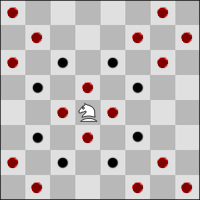
Yesterday, I was thinking about a very unique kind of chess piece: the knight. Technically, the knight is a (2,1) leaper, meaning, it moves two squares in one direction, then one square in a perpendicular direction (see black dots in picture); and it can "leap" over pieces. So, as I was saying, I was thinking about the knight, then I suddenly had the urge to improve it (or to use the chess variation lingo, "augment it"). What if, I asked myself, there was a chess variant where the knight is an (n, n-1) leaper? It could still move like the orthodox knight (i.e. n = 2), but it would be far more powerful.
(The knight as an (n, n-1) leaper.)
Powerful. That's the word. I realized that such a piece was simply too powerful for serious players to like. Imagine a piece that could leap over any number of pieces to land on almost the opposite side of the board, attacking at a maximum of 24 squares (near the center) and a minimum of 14 (on an edge). Then imagine four of those pieces on a single chessboard. The words "cheap" and "overkill" come to mind. Basically, the only way for my idea to be acceptable is to limit this augmented knight somehow...But what would be an elegant way of doing this?
In the complex plane, a regular convex \(n\)-sided polygon is the convex hull of a finite cyclic group of order \(n\) under multiplication. This cyclic group is of course the \(n\)th roots of unity in \(\Bbb{C}\).
Given this relationship between convex \(2\)-polytopes and roots of unity in that \(2\)-dimensional algebra, let's try to construct a family of algebras such that if a member algebra is \(n\)-dimensional, it has cyclic subgroups under multiplication whose convex hull is an \(n\)-polytope.
Aside from the aforementioned case with polygons, mathematicians don't usually associate cyclic groups with polytopes. Rather, it is the symmetry groups that commonly comes to mind whenever polytopes are mentioned in the context of abstract algebra. But I'd like to show that there is a very natural notion of dimensionality within finite cyclic groups under any unital algebra's multiplication operation, and that it's not always just the two dimensions of the roots of unity in the complex plane.
Polytopic Groups and Algebras
Let's define a "polytopic group" to be a finite cyclic group whose group operation is the multiplication operation of a certain algebra. The span of the group's elements within the algebra's vector space determines the polytopic group's dimensionality, and its convex hull is a polytope with the same dimensionality.
Let's also define an "\(\bf{n}\)-polytopic algebra" as an \(n\)-dimensional real algebra with \(n\)-dimensional polytopic subgroups. Meaning, the dimensionality of the algebra and its highest-dimensional polytopic subgroup is the same.
We can thus say that \(\Bbb{C}\) is a \(2\)-polytopic algebra and \(\Bbb{R}\) is a \(1\)-polytopic algebra. Unfortunately, \(\Bbb{H}\) (the quaternions) and Cayley-Dickson constructions derived from it are NOT polytopic algebras, but they do have \(2\)-polytopic subalgebras. Also, all unital algebras contain the \(1\)-polytopic subalgebra \(\Bbb{R}\).
The following is my attempt at constructing other polytopic algebras. Note that I will be focusing on algebras over the field of real numbers, but you are free to try this exercise for other fields.
In my previous post I discussed the trirational numbers, which are representations of complex numbers that can also represent ratios of three numbers. Now let's look at the generalization that represents ratios of \(n\) numbers: the \(n\)-rational numbers, or more generally the multirational numbers.
Here, \(r\in\Bbb{R}\) is called the numerator while \(d_1,\dots,d_{n-1}\in\Bbb{R}_{>0}\) are the denominators of the \(n\)-rational number.
We can say that a trirational number \(a\unicode{x25B6}b\unicode{x25B6}c\) is a \(3\)-rational number, while a fraction \(\frac{a}{b}\) is a \(2\)-rational number that can be written as \(a\unicode{x25B6}b\) (if \(b\) is positive) or \((\operatorname{sgn}(b)*a)\unicode{x25B6}{|b|}\).
Ratios and the scaling rule
When you scale each component of a ratio by the same amount, the ratio stays the same. The same applies to multirationals because of this identity:
This property allows fractions and trirational numbers to act as homogeneous forms for real numbers and complex numbers, respectively.
We'll go back to this concept of homogeneous forms near the end of this post, but first let's look at \(n\)-rational operations without referencing the ambient algebra.